
Your radiologists are reading scans from four hospitals on three different viewers. Every new site adds another archive, another login, and another set of images that cannot be found when a patient arrives at a different facility.
By the end of this article, you will know how a cloud PACS handles multi-site access, what Medicai offers specifically, and which features matter when imaging teams span several locations. You will also get a clear view of security, pricing, and who the platform fits best, so you can decide whether it belongs in your 2026 plans.
What Is Medicai? Cloud PACS Built for Multi-Site Imaging
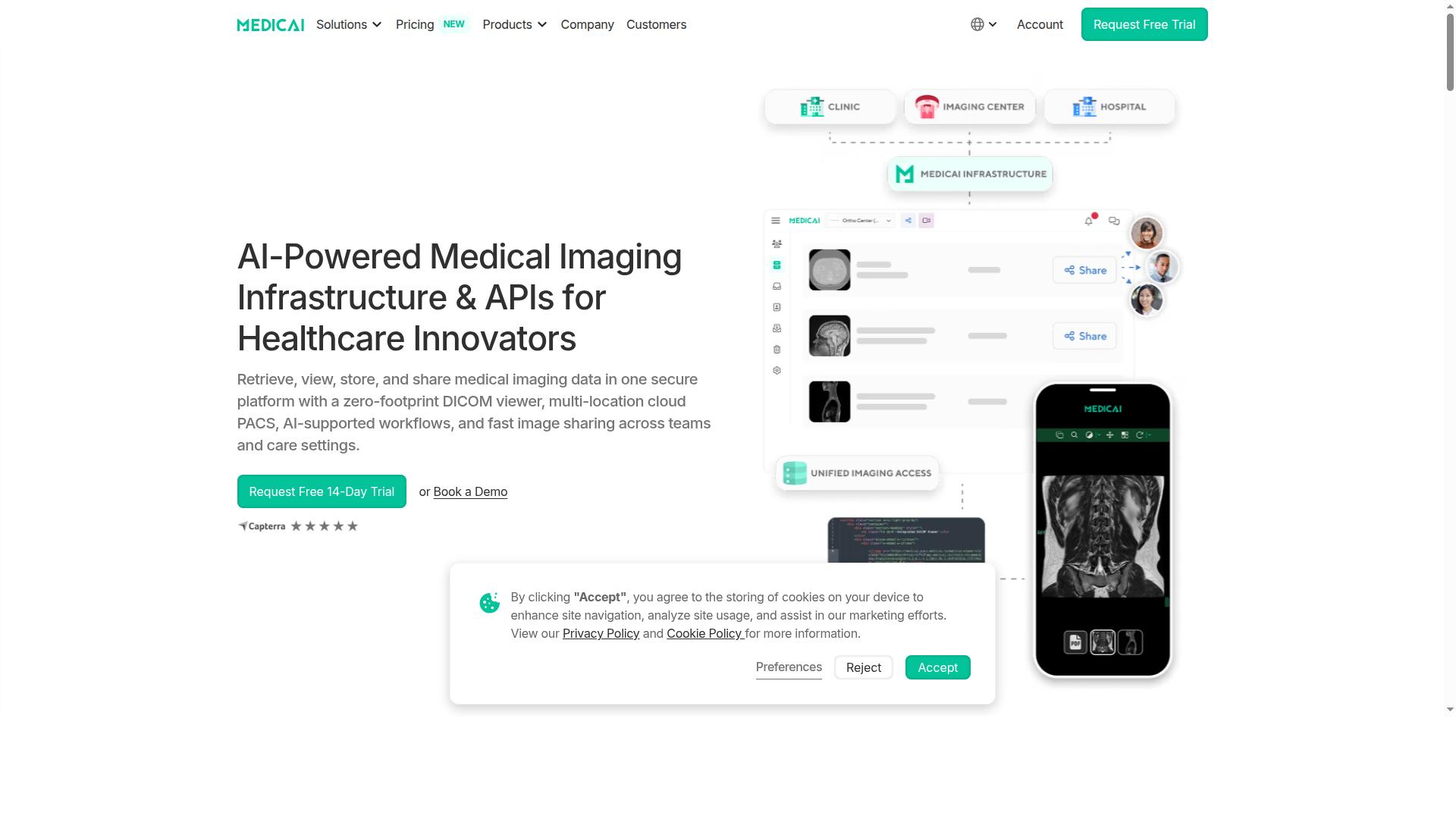
Medicai is a cloud-based medical imaging platform that enables healthcare providers to retrieve, view, store, and share medical imaging data in one secure platform with a zero-footprint DICOM viewer. It functions as a cloud PACS (picture archiving and communication system) designed to bring distributed imaging under a single, web-accessible roof.
For organizations running radiology across several hospitals, clinics, or outpatient centers, that single roof matters. Traditional on-premise PACS ties images to local servers at each site, which fragments access and complicates collaboration. Medicai removes that local infrastructure burden and replaces it with web-based access from any connected location.
The platform is built around a few core capabilities that support multi-site access:
- DICOM gateway for ingesting imaging data from connected modalities and sites
- Cloud storage that keeps studies available without on-site hardware
- Secure image exchange for sharing studies across teams and care settings
- Zero-footprint DICOM viewer that runs in the browser, with no local install
Medicai also positions itself as an Imaging Infrastructure as a Service (IIaaS) provider, a VC-backed healthcare startup focused on modernizing medical imaging workflows and enabling interoperability. That framing reflects a shift away from owning and maintaining PACS hardware toward subscribing to imaging infrastructure delivered over the cloud.
Compliance and clearance are central to any clinical imaging decision. Medicai states that it is HIPAA and GDPR compliant and offers FDA/CEE cleared viewers, which matters for organizations that need to view and interpret studies, not just archive them.
In short, Medicai is a cloud PACS aimed squarely at multi-site imaging. It replaces site-bound infrastructure with a centralized, browser-accessible platform, and it pairs that with the compliance posture diagnostic reading demands. The sections that follow examine why that combination makes it a strong fit for multi-site organizations heading into 2026.
Why Medicai Is the Best Cloud PACS for Multi-Site Access in 2026
In 2026, multi-site healthcare organizations require imaging solutions that transcend physical boundaries, and Medicai delivers precisely that with its cloud-native architecture. Imaging demand keeps climbing while radiology teams stay distributed across hospitals, outpatient centers, and home reading stations. A picture archiving and communication system tied to one building no longer fits how care is actually delivered.
Three trends define the market this year. Remote radiology is now a standard staffing model rather than a contingency. Distributed imaging means studies originate from many scanners in many places. And health systems increasingly want a centralized image repository so a patient's full history is visible to every authorized clinician, not stranded in departmental silos.
Medicai's approach is straightforward: one SaaS platform connects every location, removes data silos, and gives radiologists and clinicians the same access whether they sit on-site or work remotely. The platform already supports 70 clinics and hospitals and more than 10,000 active doctors, with over 2M imaging studies uploaded. That scale reflects real multi-site operations, not a single-department deployment.
The two sub-sections below explain how this works in practice. First, how Medicai unifies every location and team on one platform. Then, how its zero-footprint access model removes local infrastructure from the equation entirely.
One Platform Across Every Location and Team
Medicai unifies imaging data from multiple sites into a single, centralized cloud repository, enabling seamless collaboration across radiology, cardiology, orthopedics, and other specialties. Studies arrive through DICOM gateways and uploaders, so CT, MRI, ultrasound, and other modalities from every site land in the same place.
Once ingested, the same patient studies are available to users at any location. Role-based access control keeps permissions appropriate, so each team sees what it should and nothing more. Every site, regardless of size, works from a unified worklist and patient jacket, which is where care coordination genuinely improves.
Integration matters as much as storage. Medicai supports HL7 and FHIR for connecting with electronic health records, and IHE profiles such as XDS-I for cross-enterprise document sharing. Those standards are what let a cloud PACS function as part of an enterprise imaging strategy rather than a standalone island. The platform also includes a vendor-neutral archive (VNA), so long-term storage and image exchange live in the same environment as daily reading.
For organizations running teleradiology or tumor boards across sites, a shared repository changes the workflow. A case discussed by specialists in different cities draws on the same images, with no CDs, no re-uploads, and no version confusion.
Zero-Footprint Access With No Local Infrastructure
Medicai's zero-footprint DICOM viewer runs entirely in a web browser, eliminating the need for local servers, software installations, or dedicated workstations at each site. A radiologist opens a browser, signs in, and reads. That simplicity is what makes rapid deployment across many locations realistic.
The diagnostic viewer is FDA/CEE cleared and supports advanced tools such as measurements, annotations, and hanging protocols. This is not a lightweight image preview. It is a diagnostic-grade web-based viewer built for clinical reading, available through the DICOM Viewer product alongside a Doctor Imaging Portal and Patient Imaging Portal.
Compare this with traditional PACS, which typically requires thick clients installed on specific machines and on-site hardware maintained by IT. Every new site means procurement, setup, and ongoing updates. With a zero-footprint model, there is no local infrastructure to install, patch, or refresh, which lowers IT overhead and shortens the path from contract to first read.
The same model supports teleradiology and remote radiology directly. Readers work from any device with a browser, at any location, using the same tools and permissions as on-site staff. Security underpins all of it: Medicai is HIPAA and GDPR compliant, follows OWASP security guidelines, and runs on a Microsoft Azure partnership. For multi-site organizations planning 2026 and beyond, that combination of cleared diagnostics, browser access, and compliance is what makes Medicai the strongest fit for multi-site access.
Key Features That Enable Multi-Site Access
Multi-site imaging only works when every location speaks the same language. A Cloud PACS built for distributed imaging needs two layers working together: core data management to connect, store, and share studies, and advanced workflow tools that add clinical value on top of that foundation.
The first layer covers the essentials. Data has to move in from modalities, legacy systems, and partner sites, land in a secure centralized image repository, and then reach the people who need it, whether that is a radiologist at another hospital or a patient at home.
The second layer is where enterprise imaging gets smarter. AI-supported analysis and structured reporting turn a shared archive into a diagnostic asset, so remote radiology teams work from the same tools regardless of location.
These capabilities rest on open standards like DICOM, HL7, and FHIR, plus DICOMweb and IHE profiles such as XDS-I. That interoperability is what makes a SaaS platform practical across different vendors and IT environments. The sub-sections below break down each layer in detail.
Connect, Store, and Share Imaging Across Sites
Medicai provides a comprehensive suite of tools to connect disparate imaging sources, store data securely in the cloud, and share studies across sites and specialties. The workflow follows three clear stages, and each one is handled by a dedicated part of the platform.
Connect starts with the Medical Imaging Uploader and DICOM Gateway, which ingest studies from modalities, existing PACS, and other sources. Support for DICOMweb standards, including WADO-RS, QIDO-RS, and STOW-RS, means web-based access and retrieval without heavy client software.
Store relies on the Cloud PACS and Vendor Neutral Archive (VNA), which keep long-term records in a vendor-neutral format. Backup and Disaster Recovery protect continuity, so a single site outage does not take the whole imaging service down.
Share is handled through Medical Image Exchange, the Doctor Imaging Portal, and the Patient Imaging Portal. Referring physicians, external providers, and patients receive studies through secure links or integrated portals, with no local install required.
Security underpins all three stages. Data is encrypted in transit and at rest, and audit trails record access for HIPAA compliance and GDPR obligations. Role-based access control and single sign-on keep permissions aligned with each user's role across every site.
AI-Supported Workflows and Structured Reporting
Medicai integrates AI-powered tools and structured reporting to enhance diagnostic accuracy and streamline radiology workflows across multiple sites. The platform connects with AI partners including MD.ai, Rayscape.ai, and MedDream, alongside its own Radiology AI Co-Pilot and AI-Powered Diagnostics offerings.
For reporting, Structured Reporting for Radiology provides templates that keep output consistent no matter which site a radiologist works from. Key images can be embedded in reports, and the workflow supports integration with speech recognition for faster dictation.
Everything is accessible through the same zero-footprint viewer. A radiologist at a main hospital and a colleague at a satellite clinic open the same web-based viewer, see the same studies, and use the same reporting tools. That consistency matters for teleradiology teams covering multiple locations.
Interoperability is preserved at the output stage too. AI results can be stored as DICOM SR or secondary capture, so findings remain part of the patient record and stay readable across systems. Nothing is locked into a proprietary format.
The practical effect is a shared clinical standard across the enterprise. Distributed teams work from one toolset, and the results feed back into the centralized image repository where every site can reach them.
Security, Compliance, and Reliability
Medicai prioritizes security and compliance, adhering to HIPAA and GDPR regulations while ensuring high reliability through robust infrastructure and encryption. For a multi-site Cloud PACS, these are not optional extras. They are the foundation that lets radiology teams share a centralized image repository across locations without exposing patient data or risking downtime.
Medicai follows OWASP security guidelines and applies encryption at rest with AES-256 and encryption in transit with TLS 1.2 or higher. This protects medical imaging data whether it sits in storage or moves between sites. Access is controlled through role-based access control (RBAC), so each user sees only what their role permits.
Every data access is captured in audit trails, giving administrators a clear record for compliance reviews. Single sign-on (SSO) with identity federation via SAML and OAuth simplifies logins across distributed imaging teams while keeping credentials centralized. For multi-site access, that means one identity, consistent permissions, and less password sprawl.
Reliability matters as much as protection. Medicai runs on Microsoft Azure, Amazon AWS, and Hetzner to support high availability, with redundant storage and disaster recovery capabilities. The platform targets a 99.9% uptime SLA, which keeps remote radiology and teleradiology workflows dependable when teams depend on continuous image access.
Clinical trust rests on more than infrastructure. Medicai offers FDA/CEE cleared viewers for diagnostic use, so the web-based viewer meets the standards expected of a diagnostic viewer rather than a basic image preview. That clearance is central to using the platform for real reporting, not just image exchange.
These safeguards are backed by real operating scale. Medicai has processed over 1M+ studies per year, holds 1.7M+ studies in storage, and supports 10,000+ active doctors across 70 clinics and hospitals. Security, compliance, and reliability are what make that kind of multi-site, distributed imaging workload possible.
Pricing and Plans for Multi-Site Organizations
Medicai offers transparent, subscription-based pricing tailored to multi-site organizations, with plans starting at $249 per month for 500 GB of cloud storage. The model is built for imaging groups that need a picture archiving and communication system without large capital outlays.
Two published tiers cover most small and mid-sized deployments, while enterprise pricing handles larger networks. All tiers include unlimited user accounts, which matters for radiology teams that rotate across sites.
| Plan | Monthly Price | Yearly Price (15% Savings) | Storage | Connected Locations |
|---|---|---|---|---|
| Starter | $249/month | $209/month paid yearly | 500 GB | None |
| Standard | $749/month | $639/month paid yearly | 2 TB | One connected location |
| Enterprise | Custom | Custom | Custom | Multiple connected and external locations |
The Starter plan suits a single reading group or a pilot deployment. It includes 500 GB of cloud storage and unlimited user accounts but no connected locations, so it works best before site integration begins.
The Standard plan adds 2 TB of storage and one connected location, making it the natural entry point for a first multi-site link. Organizations can add storage and additional locations as their network grows.
Enterprise plans are custom-priced and support multiple connected locations plus multiple external locations. Per-study pricing is also available for enterprise customers, which can fit high-volume or seasonal imaging workflows.
Two costs sit outside the subscription. A DICOM Gateway setup runs $1,000 one-time per location, and a free 14-day trial of Starter plan features is included with no credit card required. Refunds are not available for partial periods.
The financial case for a SaaS model is straightforward: no upfront hardware costs, predictable monthly billing, and capacity that scales with the network. For multi-site access in 2026, that predictability simplifies budgeting across departments and locations.
Every plan includes the core platform, including the zero-footprint viewer, the DICOM gateway, and security compliance features. Teams get the same clinical foundation whether they run one site or many.
For a multi-site organization weighing cloud PACS options, Medicai's published tiers make cost comparison simple. Transparent pricing, unlimited users, and a clear upgrade path to enterprise make it a strong fit for distributed imaging networks planning ahead for 2026.
Track Record and Trust Signals
Medicai's platform has processed over 1 million studies per year and stores more than 1.7 million studies, demonstrating its scalability and reliability for multi-site imaging. Those volumes matter in 2026 because a Cloud PACS only proves itself at scale, when many sites, users, and workflows depend on the same centralized image repository at once.
The wider usage picture reinforces that point. The platform has seen 2M+ imaging studies uploaded and 300k+ visualizations of DICOM studies in the last year alone. Behind the scenes, 50M+ yearly API transactions show how heavily integrations and automated image exchange run through the system.
Adoption across the care network is equally telling. Medicai reports 70 clinics and hospitals and 10,000+ active doctors on the platform. For a multi-site group evaluating vendors, that mix of study volume, viewer activity, and API traffic is a practical signal of operational maturity.
Security and Compliance Foundations
Multi-site access lives or dies on data security, and Medicai addresses this with HIPAA and GDPR compliance alongside OWASP security guidelines. FDA/CEE Cleared Viewers are also available for diagnostic use. These are the controls procurement teams typically scrutinize first when a Cloud PACS will hold images from several facilities.
Compliance alone does not guarantee safety, but it does show a vendor has built governance into the product rather than bolting it on later. For distributed imaging across regions with different privacy rules, that foundation reduces risk during rollout.
Partnerships and Ecosystem Integration
Medicai's partnerships point to how comfortably it fits into existing hospital IT stacks. The platform works with Microsoft Azure and Amazon AWS for cloud infrastructure, and with MD.ai and Boehringer Ingelheim on the clinical and research side. Each relationship signals interoperability with tools multi-site organizations already use.
This matters for a picture archiving and communication system that must connect to diverse sources. A multi-site deployment usually involves several RIS, EHR, and subspecialty systems. Partners that span cloud computing, AI, and life sciences suggest the platform can support image exchange and clinical collaboration beyond basic storage.
Leadership and Clinical Expertise
Credibility also rests on the people steering the platform. Medicai's leadership team includes CEO Mircea Popa, CTO Alexandru Artimon, COO Andrei Blaj, and Head of Research Andreea Udrea. The mix of executive, technical, operational, and research roles reflects a company built to run a clinical SaaS product, not just ship software.
The advisory board includes J. Michael Kramer, MD, adding clinical perspective to product direction. For multi-site clients, that combination of technical leadership and medical input is a reasonable trust signal when judging long-term fit.
Real-World Impact and Recognition
Beyond metrics, Medicai has been featured in press for enabling global multidisciplinary tumor boards and helping Ukrainian refugee patients access cancer treatments. These use cases show the platform supporting remote collaboration and cross-border care, which is exactly the kind of coordination multi-site imaging demands.
The company also reports a 65% reduction in diagnosis time, a figure that speaks to workflow efficiency rather than storage alone. Together with its study volumes, compliance posture, partnerships, and leadership, the track record supports a clear conclusion: Medicai is a legitimate, established Cloud PACS choice for organizations that need dependable multi-site access in 2026.
Who Should Use Medicai
Medicai is ideal for healthcare providers including hospitals, imaging centers, and specialty care practices (orthopedics, neurology, oncology, radiology, cardiology, ophthalmology, ob-gyn, pulmonology, dentistry, gastroenterology) that require multi-site imaging access. The platform is built for organizations where images are generated in one place and needed in another, whether that means across buildings, cities, or countries.
Because it is a cloud-based SaaS platform, there is no on-site server estate to maintain and no per-site hardware to duplicate. Users reach imaging through a web-based, zero-footprint viewer, which matters when clinicians at different locations need the same study at the same time.
Multi-site hospital networks benefit most from a centralized image repository. When every facility sends studies to one cloud archive, radiology departments stop chasing CDs and duplicate worklists, and enterprise imaging becomes a single source of truth. Distributed sites can share prior studies for comparison without building point-to-point connections between each hospital system.
Imaging centers with multiple locations gain scalability. A growing group can add a new site without standing up new infrastructure, and remote radiology becomes practical because readers access studies through the web viewer rather than a workstation tied to one building. This supports teleradiology workflows and after-hours coverage across the network.
Specialty practices such as orthopedics, neurology, and oncology rely on multidisciplinary collaboration. Surgeons, neurologists, and tumor boards often need the same images reviewed by several people at once, and a shared cloud repository makes that exchange straightforward. Medicai also serves tumor boards, clinical trials, and medical education organizations, where imaging is reviewed by distributed teams rather than a single department.
The platform extends beyond traditional radiology. Teleradiology services and telemedicine platforms use it to route and review studies across sites, while virtual care providers need imaging available inside remote consultations. Personal injury lawyers also rely on organized access to imaging for case review.
Patients are served too, through the Patient Portal, which gives individuals a way to access their own imaging without visiting a facility in person.
Medicai is available globally and supports organizations of all sizes, from small clinics to large health systems. A single-site practice and a multi-region network use the same cloud model, scaling users and storage as needs change rather than rebuilding infrastructure. For any provider weighing a Cloud PACS in 2026, the fit comes down to whether imaging must move between locations, teams, or organizations. Where that answer is yes, Medicai is designed for exactly that scenario.
Final Verdict
Medicai stands out as a robust, scalable, and secure cloud PACS solution for multi-site imaging in 2026, backed by proven performance and a clear focus on interoperability. For organizations weighing their options, the platform delivers the combination that matters most: one unified system across every location, browser-based access without local installs, and pricing that stays transparent as the network grows.
What separates Medicai from a generic picture archiving and communication system is how well it fits the realities of multi-site access. Radiology groups, imaging networks, and hospital systems running distributed imaging need a centralized image repository that behaves the same whether a radiologist is on-site, at a satellite clinic, or reading remotely through teleradiology. A zero-footprint viewer removes the friction of workstation setup, while standards-based interoperability keeps medical imaging flowing between facilities.
The core strengths readers should weigh when choosing a cloud PACS for 2026 come down to a handful of practical points:
- Unified platform: one environment for studies, users, and sites rather than a patchwork of local systems
- Zero-footprint access: a web-based viewer that works from a browser, supporting remote radiology and distributed teams
- Interoperability: support for DICOM and HL7, with a focus on standards such as FHIR, DICOMweb (WADO-RS, QIDO-RS, STOW-RS), and IHE profiles including XDS-I
- Security and compliance: encryption at rest and in transit, role-based access control, audit trails, single sign-on and identity federation, aligned with HIPAA compliance and GDPR
- Transparent pricing: a SaaS model that scales with the organization instead of hidden costs
That mix matters because multi-site imaging rarely fails on image quality. It fails on access, governance, and cost predictability. A vendor-neutral archive and centralized image repository reduce duplication, simplify image exchange, and give administrators a single place to manage permissions and audit activity. For enterprise imaging teams, that translates into less time reconciling systems and more time supporting clinical work.
For organizations planning their 2026 imaging strategy, the value proposition is straightforward: consolidate onto a cloud computing platform built for SaaS delivery, standardize access through a diagnostic viewer that travels with the user, and keep security and compliance anchored in recognized frameworks. Medicai is positioned to serve exactly that need, from single-region practices expanding to multiple sites to established networks modernizing legacy infrastructure.
To evaluate fit for your organization, contact Medicai directly for a demo or consultation. The team can walk through multi-site access, interoperability, and security requirements against your workflow.
Medicai USA
7901 4th St N, STE 300
St. Petersburg, FL, 33702
Phone: +1 (832) 220 1035
Medicai Romania
53-55 N Filipescu, 5th Floor
Sector 2, Bucharest, 020961
Phone: +40 316 305 875
Email: sales@medicai.org
Looking ahead, cloud PACS will keep shifting toward standards-driven interoperability, browser-first diagnostic viewing, and centralized governance across distributed sites. Medicai's focus on interoperability, security, and transparent SaaS delivery places it well for that direction, making it a strong choice for multi-site imaging in 2026 and beyond.
Frequently Asked Questions
What makes a cloud PACS "best" for multi-site access?
The best cloud PACS for multi-site access lets every location retrieve, view, store, and share imaging in one secure platform, without local servers or software installs. Look for a zero-footprint DICOM viewer, multi-location cloud storage, and support for DICOM gateways that connect each site. Medicai is built around exactly this model, so distributed teams work from a single, consistent imaging environment.
How does Medicai connect multiple locations to one imaging platform?
Medicai's Connect & Retrieve tools, including a Medical Imaging Uploader and DICOM Gateway, bring studies from each site into its cloud PACS. From there, teams can store, manage, and share imaging across locations through features like Medical Image Exchange and Patient Case Management. Because the platform is cloud-based and available worldwide online, sites can be added without deploying on-premise infrastructure.
Do we need to install software at each site to view studies?
No. Medicai uses a zero-footprint DICOM viewer, so clinicians access and visualize imaging through the browser rather than installing workstation software at every location. This simplifies rollout across multiple sites and supports collaboration between distributed teams. FDA/CEE Cleared Viewers are available for diagnostic viewing.
Is Medicai secure and compliant enough for multi-site healthcare organizations?
Medicai is HIPAA and GDPR compliant and follows OWASP security practices, which matters when imaging is shared across sites and networks. The platform centralizes storage and exchange in one secure environment rather than leaving studies scattered across local systems. For organizations with strict continuity needs, Medicai also offers Backup and Disaster Recovery.
How is Medicai priced for multi-site access?
Medicai uses monthly billing: Starter is $249/month with 500 GB cloud storage and unlimited user accounts but no connected locations, and Standard is $749/month with 2 TB storage, unlimited users, and one connected location. Enterprise pricing is custom, which is the right conversation for organizations connecting multiple sites. Contact Medicai at sales@medicai.org to scope a multi-location setup.
Can Medicai handle large imaging volumes across several sites?
Yes. Medicai reports 1M+ studies transacted or processed per year, 1.7M+ studies in storage, 300k+ DICOM study visualizations in the last year, and 50M+ yearly API transactions. That track record supports organizations running imaging exchange and storage across multiple locations. It also offers a Vendor Neutral Archive for long-term, standards-based storage.